
 English
 Español
 Français
 简体中文
简体中文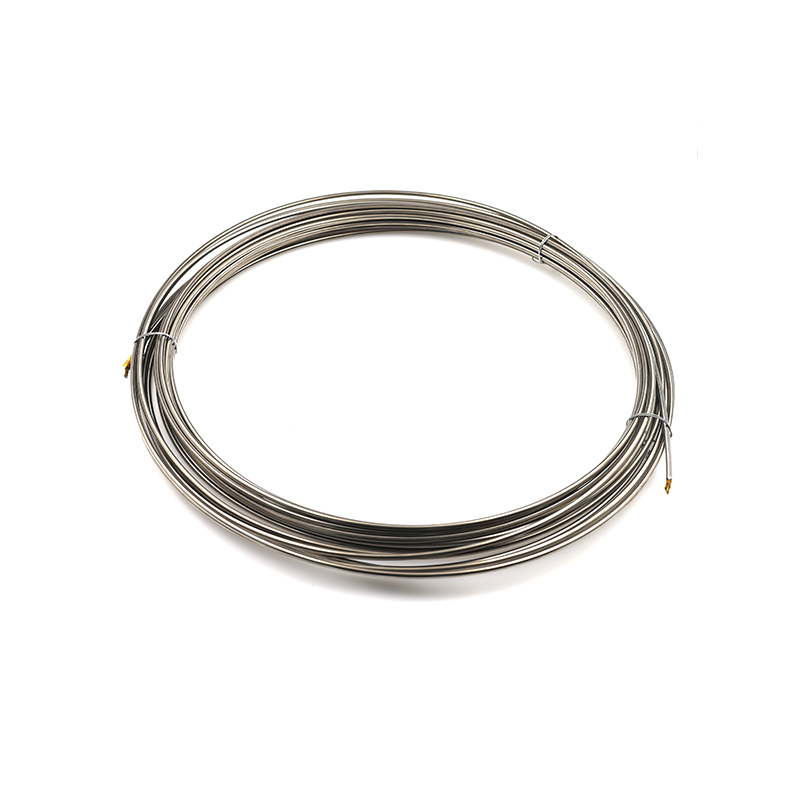
Product Model: SKKPLS-4*0.22mm Structure Coated high-toughness copper conductor 7 x 0.20mm Pol...
Stainless Steel Signal Cables Manufacturers
The stainless steel signal cable is composed of solid coated high-toughness copper conductor, polyimide insulation layer, polyimide filling layer, and 316L stainless steel tube. The entire sheathed complex forms a multi-layer protective structure to ensure zero interference in signal transmission under harsh conditions such as temperature, strong corrosion, and high vibration. The product has high strength and flexibility. The armored outer sheath is passivated to form a chromium-rich oxide film, which significantly improves the rust resistance and eliminates frequent maintenance. This product can be custom-made, the core wire can be double-core wires, four-core wires, six-core wires, or eight-core wires. The products are mainly used in oil wells, deep sea, navigation, the chemical industry, and other fields.
| Conductor Material | Coated high-toughness copper conductor |
| Conductor Size | 0.2mm×7 |
| Insulation Material | Polyimide |
| SUS316 Tube Thickness | 0.4mm |
| Cable Diameter | 4.0±0.05mm |
| Cable Temperature Resistance | -50℃ to +380℃ |
| Cable Breaking Force | 9kN |
| Minimum Bending Radius | 200mm |
| Withstand Voltage | 300VDC |
| Insulation resistance of cable at 20 ℃: | ≥500MΩ·km |
| DC resistance of cable at 20 ℃: | ≤86Ω/km |
| Cable Capacitance | ≤0.17μF/km |
| Number of Cores | 1 pair, 2 pairs, 3 pairs, 4 pairs |
| Custom Lengths | 10mm-1000m |
| Special Applications | Oil well, Deep sea, Navigation, Chemical industry |
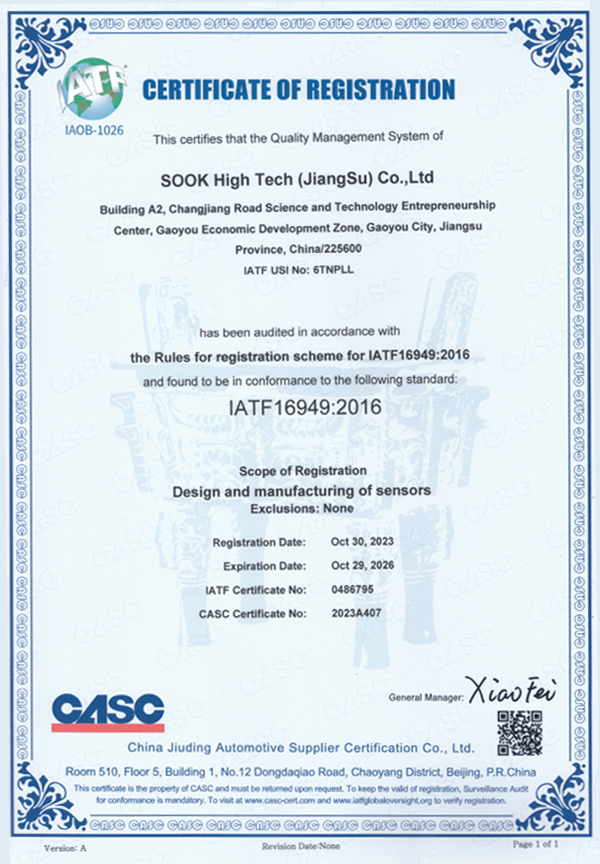
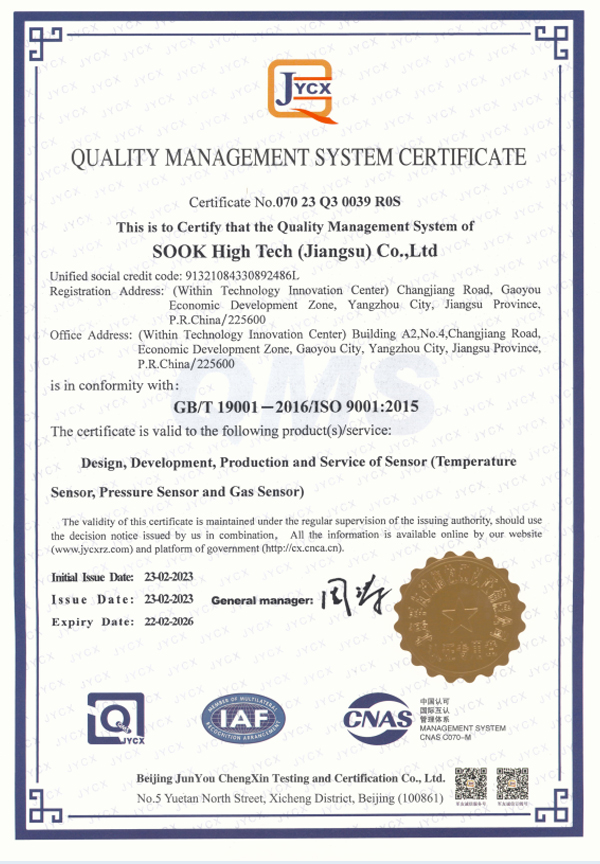
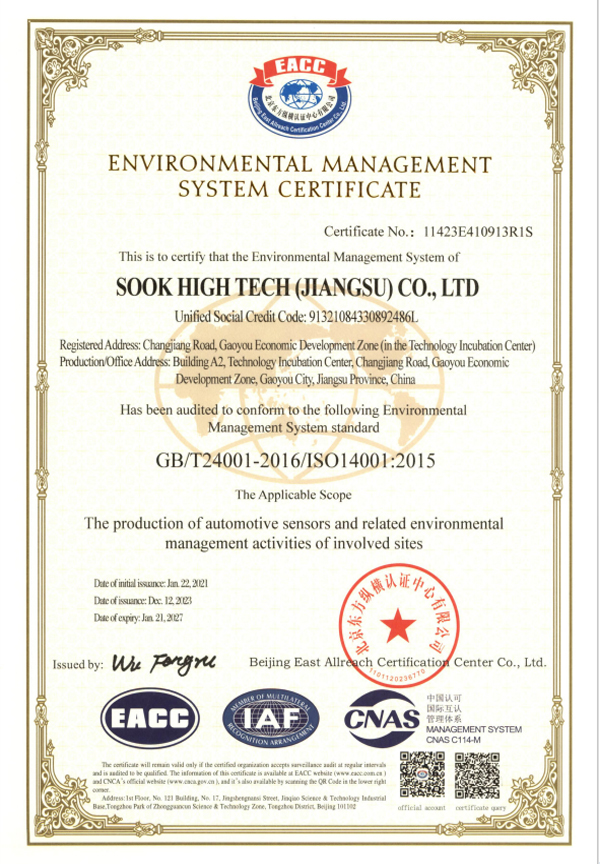
Certificate
Specializing in the research and development of intelligent vehicle exhaust temperature sensor, intelligent NOX sensor, NH3 sensor, H2 sensor and speed sensor, design, production, sales and integration.
ABOUT US
Sook High Tech (Jiangsu) Co., Ltd.
Sook High Tech (Jiangsu) Co., Ltd. was established in 2015, with a registered capital of 30.5 million yuan. Has won High-tech enterprise, National science and technology small and medium-sized enterprise, Software enterprise, Member of China Machinery Industry Standardization Technology Association, Council Members of Sensor and IoT Industry Association, Council Members of China Instrument Industry Association Sensor Branch and Council Members of Jiangsu Import and Export Chamber of Commerce.
As a professional China OEM Stainless Steel Signal Cables Manufacturers and ODM Stainless Steel Signal Cables Factory
, SOOK High Tech focuses on the design, production, sales and integration of various sensors for smart cars and industrial fields, as well as cables and heaters for the industrial field.
Has an annual production capacity of 600,000 sensors of various types. There are more than 2,000 items of exhaust temperature sensors, 450 items of NOx sensors, and 1,300 items of ABS sensor, which are exported to Europe and the United States.
Message Feedback
Recent News
Learn about our industry exhibition information and recent events in our company.
-
What are the core differences between Armored Heaters and ordinary heaters?
Armored heaters outperform ordinary heaters in mechanical protection, heat uniformity, lifespan, and suitability for harsh environments. While ordinary heaters may suffice for ho...13 -
What types of sensors are there?
Types of Sensors – A Complete Guide Sensors are the foundational building blocks of modern automation, manufacturing, automotive systems, and smart infrastructure. There are hundr...06 -
Does the ABS Sensor Affect the Vehicle's Computer?
The health of the ABS sensor directly affects the vehicle's computer (ECU) judgment. Sensor malfunctions can not only cause ABS failure but may also affect other systems: Affectin...27 -
What are the differences in the role of the NTC EGT Sensor in gasoline and diesel engines?
The NTC EGT Sensor primarily acts as a "guardian" in gasoline engines. Its core function is to prevent damage to critical components (such as the three-way catalytic converter) due...20
Stainless Steel Signal Cables Industry knowledge
What are the typical applications for stainless steel signal cables?
1. Oil wells and deep-sea drilling: In the high-pressure, high-temperature, and highly corrosive downhole environment, 316L stainless steel sheaths resist corrosion from seawater and salt spray, ensuring interference-free signal transmission.
2. Shipbuilding and marine navigation: Navigational instruments and deep-sea sonar require extremely high signal integrity. A combination of multi-layer polyimide insulation and stainless steel sheaths ensures long-term reliable operation in high-vibration and salt spray environments.
3. Chemical and petrochemical plants: Temperature, pressure, and flow sensors in production lines are often exposed to strong acids, bases, and corrosive gases. The passivation film on the outer layer of 316L stainless steel provides excellent rust resistance, reducing maintenance frequency.
4. Smart cars and industrial automation: In engine compartments or robot joints subject to high vibration and high temperatures, signal cables require both flexibility and strength. Sook High Tech's customized multi-core structures (dual-core, quad-core, hexagonal, and octal-core) precisely meet these requirements.
How should I choose a stainless steel signal cable based on transmission distance and signal frequency? 1. The higher the signal frequency, the faster it attenuates.
High-frequency signals experience greater capacitive coupling and skin effect when transmitted over long distances, leading to signal distortion. Reducing the frequency or using a larger copper conductor can effectively extend the transmission distance.
2. Voltage and Wire Diameter Combination
Increasing the drive voltage and increasing the conductor cross-sectional area (e.g., using multiple strands of thin copper wire) can reduce line impedance and improve signal integrity over long distances.
3. Maximum Cable Length Calculation
Based on the instrument loop current (typically 20mA) and the power supply voltage (24VDC), signal cable runs are generally within 100m within a load range of 500Ω–750Ω. For longer distances, shielded twisted-pair cables or repeater amplifiers can be used.
4. Multi-core Cable Selection
For systems that require simultaneous transmission of multiple signals (such as four- or eight-channel sensor arrays), multi-core stainless steel signal cables provide unified protection within a single sheath, preventing cross-interference and improving overall reliability.

ADD: Changjiang Road, Gaoyou Economic Development Zone, Jiangsu Province, 225600, China(within the Technology Innovation Center)
Copyright © Sook High Tech (Jiangsu) Co., Ltd. All Rights Reserved. China Stainless Steel Signal Cables Manufacturers Custom Stainless Steel Signal Cables Factory

